Friday, August 13, 2010

Gunung Gading, try saying that three times fast!


12-13 August 2010
"It's like walking in a sauna" -Nick

We found ourselves heading uphill on yet another rocky trail at yet another national park to the sound of of a cicada whose reverberations mimicked the sound of someone strumming a single note on a sitar.

We had hopped on a bus for an overnight trip to Gunung Gading National Park which is widely known as one of the premier spots for spotting blooming Rafflesia, the "largest flower in the world" that of course stinks of rotting flesh. Unfortunately, this would not be blooming for "maybe two weeks, maybe next week, we just don't know". We headed there anyway, a botanical fools-quest.

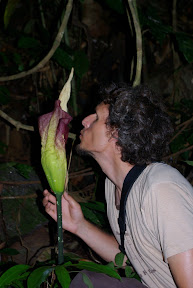
Sadly, the park officials at the park entrance again reiterated that the Rafflesia were not blooming. However, almost as a consolation prize (though equally as cool), we were lucky enough to spot a blooming Amorphophallus hewittii (common names: Borneo titan flower or (my personal favorite) giant voodoo lily). This plant also smells like rotting flesh (yay!) and we had been searching for it ever since spotting its leaves and fruits in Gunung Mulu National Park!!


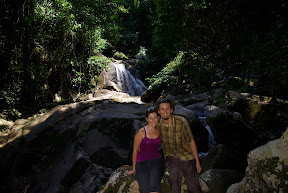
Besides the Rafflesia, Gunung Gading boasts a few beautiful waterfalls, some nice overlooks, swimming holes, and a summit trail. We walked the waterfall trail, had lunch at the beautiful and creatively named "Waterfall #7" and headed directly for the Gunung Gading summit. Don't laugh, but we did not make it to the summit. We trudged upwards for a few hours, sweating as if we were sitting in a sauna, getting dizzy and, in our delirium, jumping every time we spooked a skink or lizard. We had less than a liter of water and 800 meters to go. Somehow, the 3km (about 1.4 miles) trail had taken us about 3 hours to complete...we must have forgotten how to walk (or someone forgot how to count). After resting on a giant tree root for about 15 minutes, we choose to abandon the summit. There was no view anyway. We headed downhill, walking at a pace of 1km per hour downhill, apparently. Note to self: Do not trust Malaysian national park maps.

About halfway down the trail we spooked some white/pink colored bats (I swear its true)!! They swirled around us for a few seconds - we mystified, they horrified - before they found another resting place. Just a few moments later I gasped. In the middle of the trial in front of us was a beautiful green lizard who bore a striking resemblance to our poor sweet water dragon. More exciting was that this female lizard was digging a hole for what we presumed were her eggs! After getting over the initial shock of our presence she continued to dig with her mouth and hands as we looked on (we will try to post this video, but we are having some resolution problems at the moment).

Leaving her to the important work of burying her eggs (something we know nothing about), we continued on the trail and Nick spotted the aforementioned giant voodoo lily!! We were hot, tired, out of water, drenched in sweat (and I mean literally), but felt like we had found the pot of gold at the end of the rainbow.

After a cold shower and some well deserved Oreo cookies, we plotted our search for the Rafflesia the next day.


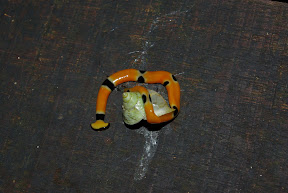
While the Rafflesia were not in bloom during our visit, our encounters along the way made this trip extremely rewarding. While Nick photographed an orange and black banded hammerhead flat worm this morning (we had no idea what this was at the time) I began to realize what made this trip to Borneo so special to me. In the past three weeks I have recaptured the 8 year old child with a butterfly net wondering in my parents big backyard. We have seen so many strange and beautiful animals, plants, insects, reptiles, and "what is that's" that I have literally, cooed, giggled, squealed and jumped up and down at least fifty times. For the nature lovers out there- those that don't mind being dirty, sweaty, and stung by fire ants - Borneo is heaven on Earth!
Continue Reading...

Tuesday, August 10, 2010

Beach Day at Bako


10-11 August 2010
As it is such an easy day trip from Kuching, we headed back to Bako National Park to visit one of its beautiful beaches! We woke up early and went down to the waterfront to catch the bus that is supposed to arrive somewhere between 7 and 7:30am. We arrived at the park and headed directly for the Lintang trail (hoping to avoid any further harassment by the macaques). We branched off from that trail after a few kilometers for the Telok Pandan Besar overlook and then onto the Telok Pandan Kecil beach.

As and aside, I would like to take a moment to comment on the trail maps, specifically the trail distances that are repeatedly incorrectly reported in many of the national parks we have visited. It would take a very small effort to fix these issues, ranging from the apparent use of "as the crow flies" distances to what appear to be guesses (if you are reading this Ingrid, we think your idea of starting an NGO to do international GIS work for national parks, etc. is a genius idea - lets get some grants!).

Anyway, we (Nick, Lauren from Canada, and I), hiked up to the kerangas, drooled over the pitcher plants, sweated our brains out, and then headed to the beach! We were so lucky to be the first to arrive that day!!! We arrived at this tropical paradise and had the beach to ourselves for about twenty minutes before boatloads of tourists arrived. We sunbathed, floated in the warm green-tinged water, admired the sandstone formations, watched armies of crabs scurry across the beach, hunted for cycads, and sunbathed some more. As noon approached, the sun became overwhelmingly hot (as it tends to do near the equator) and Nick was finally able to put his hiking pole/umbrella idea into action. He quickly rigged up our two hiking poles (brought specifically for the beach, not the hike) to our two umbrellas and we were the envy of the beach in a matter of seconds as we enjoyed the shade and the others retreated back to their boats in search of a less sweltering location.


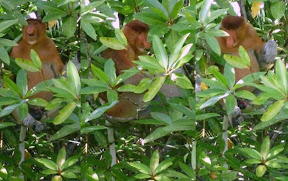
After hiking through the stifling heat to catch our boat (now wishing we had paid the 7 ringgit for a boat), we were greeted by a troop of proboscis monkeys and finally got a good look at a male! Check out that nose!


On our way home, we stopped at the Kuching Food Festival and grazed on chicken satay, sausages, fried yam on a stick, deep fried ice cream, mini fish burgers, honey mustard nachos, sweet peanuts in a gluten bar(?), sticky rice roll with meats, sweet rice with banana, and many more. Yum!!

This evening we embarked on a river boat cruise down the Santubong River and were lucky enough to see Irrawaddy dolphins, proboscis monkeys, and fire flies. The tour (run by CPH Travel) was over priced and crowded, but as the sun went down the stars, fire flies, phosphorescence in the water, lightning in the distance, and fireworks to mark the 1st day of Ramadan brought us back to the magic that is Borneo.

Tomorrow we head out for an overnight trip to Gunung Gading National Park to see the buds of Rafflesia (sniff sniff, it's not blooming) and hike on its numerous trails.
Continue Reading...

Sunday, August 08, 2010

(Bacony)-Bako National Park


7-August-2010

After an early morning walk, van ride, and boat trip we waded ashore at Bako National Park and paid our entrance fees. Still feeling marginally awake we watched with awe as a herd of Borneoan bearded pigs advanced on the park headquarters and proceeded to munch on coconuts and other plant material within feet of us tourists. After numerous encounters with wild pigs in the field back home, both Rachel and I were not too interested in getting to know the temperament of these Borneo-endemic swine. These guys and gals were big (some of them must have weighed well over 300 pounds), and they pretty much look like "normal" wild pigs with goatees. This was our introduction to Bako, Sarawak's first national park, perched on a peninsula that juts out into the South China Sea.

As we were observing the pigs, movement in the trees signaled monkey's overhead. Gazing upward we expected to see the common, long-tailed macaques. Surprise! Advancing overhead was a troop of proboscis monkeys. Proboscis monkeys are truly spectacular animals. Endangered and restricted to a limited number of locations on Borneo, they are easily recognized by their enlarged noses. The proboscis males of this species can get quite large, such that they look like they are wearing large sausages attached to their faces. We watched and took photographs as these gentle herbivores munched on leaves and swung around in the trees above. All of this and we were still just steps away from the park headquarters.

We began our long day hike with our friends and traveling-companions, Lauren and Elliot, along the Lintang and Telor Paku trails eager to explore more of Bako's natural wonders. Hiking first on Telor Paku we emerged from sandstone cliffs onto one of the most idyllic beaches we have ever visited. We were tempted to spend the entire day in this spectacular setting of clean sand ringed by dense cycad-rich hillsides and bordered by picturesque sandstone formations. The one main deterrent to a lazy day on the beach was the presence of saltwater crocodiles in Sarawak's coastal waters-yikes!

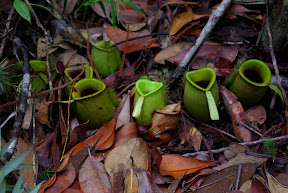
Continuing our hike on the Lintang Trail we climbed a moderate-sized hill and emerged into a Mars-esque landscape of exposed pock-marked sandstone filled with water from the previous night's rain and stunted vegetation. We soon realized that we were in Bako's heralded keranga habitat. The keranga habitat we observed in Gunung Mulu National Park was much less harsh and was lush in comparison to this landscape. It wasn't long before we began to notice pitcher plants of the genus, Nepenthes. We had heard from a fellow traveler that there were pitcher plants on the trail, but were were not expecting the botanical wonders of the next several hours. For the next 3-4 hours we hiked in and out of Nepenthes habitat observing millions of pitcher plants. Not trying very hard we tallied at least seven different species (with two species observed in Mulu, that makes a total of nine species for the trip) of pitcher plants. The hike even threw in some sundews (Drosera) and Pinguiculas to satisfy our appetite for carnivorous plants.

The variation in Nepenthes that we observed was outstanding. They occupied numerous habitats-from dense forest to exposed swampy areas cloaked with moss. We found them growing on bare soil and hanging vine-like from tall trees. Filled with water and partially-digested insects they ranged in size from the size of my pinky-finger to nearly the size of my head. And, they ranged in color from plain, pale green to a pattern which resembled a red and green tie-dyed t-shirt.

Hiking back to park headquarters though a forest rich with so uncountable species of palms we observed another troop of proboscis monkeys (one female carrying a baby-so cute) parading through the canopy. What a fitting end to a memorable hike!

Hungry from all of the hiking and botanizing the four of us stopped in for a snack at the park's cafe. If you ever wanted to see monkeys gone bad this would be a good place to start. The macaque problem at the cafe is so bad that they have even hired a guy to sit out front and protect tourists from monkey attacks by pelting the constantly-advancing macaques with rocks.

Q: What do you do for a living?
A: Oh, I work at a restaurant.
Q: Cool, are you a waiter?
A: Not exactly, I shoot monkeys with a slingshot.

Okay, calm down PETA, no monkey's were harmed in the making of this blog post. Seriously, macaques are no laughing matter. We observed numerous near-attacks on tourists while we sat at the cafe. These little guys are scary. Lauren even had one of the little buggers jump onto her backpack early in the day because she was carrying an apple. Watch your back.

Sitting on the beach, waiting for our boat, staring at the ocean's beauty we chatted about the great hike and maintained a state of "constant vigilance" to ensure that no macaques were sneaking up on us. Not far behind us, a troop of proboscis monkeys grazed in the trees as we boarded our boat back towards Kuching.
Continue Reading...

Friday, August 06, 2010

Caves, Caterpillars, and Kerangas


1st -6th August 2010

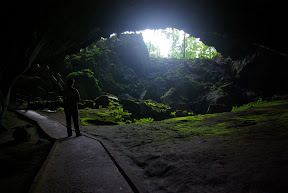
Landing on the small airstrip, surrounded for miles and miles by meandering rivers and rainforest, we were ready for an adventure. Because travel arrangements are oddly difficult to this very popular national park, we had a tour company arrange our accommodation, our visits to the caves, and our trek to the Pinnacles. We were picked up, informed that something was wrong with our budget accommodation and that we would instead be staying at the luxury resort – the Royal Mulu. From the airport we headed out to see the Deer Cave (with the largest opening of any cave in the world) and watch the exodus of over 5 million bats at sunset. We quickly changed our shoes and headed directly to Gunung Mulu National Park. The Deer Cave is full of beautiful stalagmites and stalactites, millions upon millions of bats clinging to the high ceilings, and of course tons of guano! We were pleasantly surprised as it did not smell as horrible as we imagined. We exited the cave as the sun was setting and the bats had already begun their mass exodus. Besides the indescribable sight of these hungry bats, the cave itself was just gorgeous. As we reached the bat viewing platform, many of us laid down on the wood planks and watched the constant stream of bats for about an hour.

We were dropped off at the Royal Mulu Resort, checked into our rooms and handed meal vouchers. We really did not know what to expect – as we had heard that this spot was overpriced but also very nice. We had paid for budget accommodation and were needless to say pretty excited about our room and the delicious buffet dinner (they even had masterfully-roasted turkey) and yummy breakfast (waffle bar!!!) we enjoyed during our one night stay. In the morning we were picked up in a longboat and headed upstream to the Clearwater Cave (a river runs through it) and the Cave of the Winds (windy in one spot-imagine that) – both of which were extremely beautiful. After lunch, our five person group hopped back into a longboat for the hour or so ride to the trailhead for Camp 5 – the base for the Pinnacles Trek.

The longboat ride to the trailhead was gorgeous. We traveled up Melinau River, a much smaller river than any we had “longboated” up before. As this shallow, shady river wound its way upstream we took in views of the limestone formations, watched the butterflies and dragon flies who raced our boat, counted the multitude of giant logs that lined the banks and jutted out of the river, and watched swaying adventitious roots as they reached desperately for the river. We walked a quick 9km or to Camp 5 through dense rainforest and arrived in the mid afternoon to ready ourselves for the Pinnacles Trek early the next morning.

The Pinnacles Trek ascends over 1000 meters up the vertiginous Gunung Api (gunung is Malay for mountain) in just 2.5km (just over a mile) to the Pinnacles – limestone spires that are the remnants of the interior of an ancient collapsed cave. While only about a mile long, the uphill stretch takes around three hours on a 75% slope. The hike has an epic reputation. Scrapes and broken bones are not uncommon. Deaths are rumored but our guides refused to speak of these alleged incidents out of superstition. Needless to say, we were a little apprehensive going into our bid to view the Pinnacles.

While the uphill is daunting, the downhill slips and slides on muddy, mossy tree roots back down the steep gradient and can take up to five hours. Imagine – a 5km (2.3 mile) hike that takes around 8 hours. This may sound like unnecessary torture, and the guides may only allow you 30 minutes at the top to enjoy the Pinnacles, but like so many hikers before us we came to Gunung Mulu hoping to reach the top! The thing no one mentions (until you receive your briefing the evening before, after you’ve already walked the 9km to the trail head and paid the fees) is that you will not be allowed to hike if it is raining at the 6:30am departure time. Well folks, welcome to the rainforest. In fact, the area around the Pinnacles receives more than 6000 millimeters per year. Okay, do the math- that is about 20 feet of rain. Yikes!

The rain that began the day of our arrival continued through the night, and much to our dismay it was still going at our 5:30 am wake-up call. Nervous and impatient we milled around watching the rain, praying for sun, drinking weak coffee, and waiting for the verdict from the park ranger. “We are sorry to inform you that there will be no climbing to the Pinnacles today, it is just too wet. We are sorry. We know that you have come a very long way and paid much money.” You got that right, Mr. Ranger. We figure that the 22 hour downpour that canceled our hike must have amounted to about 10 feet of the area’s rain budget (maybe a little bit of exaggeration). This was the only day, so far, in our month of travel in Malaysia, in which it has rained in the morning. Was this bad luck or some sort of omen from the spirits of the Pinnacles?

The day, however, was not a total loss. In mid-afternoon, in a break in the weather, we took the opportunity to explore the Kerangas Trail with our Iban (a tribe famous for headhunting in the not so distant past) guide and some new friends-kindred spirits, the five of us bound together by dashed trekking dreams, small talk, and innumerable games of cards. The keranga geologic formation is tropical phenomenon formed by uplifted river sediments that that have been leached by 6000 mm of rain per year for many, many years. The result is very shallow, acidic soil, stunted plants, and (yahoo!) carnivorous, pitcher plants of the genus Nepenthes. Pitcher plants thrive in this tough environment by munching on insects (more Nepenthes and fewer mosquitoes please). The day was redeemed as we walked in light rain to the top of this formation, gathering leeches along the way, reveling in the unique habitat where these beautiful, carnivorous plants live.

We departed Camp 5 the next morning more than a little disappointed but ready to explore the rest of the park and eager to scrub our quickly accumulating jungle grunge of mud, sweat, and insect repellant off with a proper shower. The jungle and the landscape of Gunung Mulu National Park are undeniably beautiful. This place has caused us to slow down and take notice of the many small details that make rainforest habitats so special. Minute orchids cling to tree bark and gigantic bird’s nest ferns hang from tree branches framed by the backdrop of vertiginous limestone cliffs covered in moss. Strolling on muddy trails and wooden boardwalks we have marveled at the park’s tranquil, slow rivers that meander past gigantic old-growth trees, whose tannin-rich leaves stain the water a translucent, rich brown. Mulu is a butterfly-lover’s dream. They literally come in all sizes and colors of the rainbow. The most spectacular of which is, perhaps the Raja Brooke -with a six-inch wingspan, a black body, a neon green wings, and a firecracker-red head. And, of course, all of these butterflies spend part of their life as caterpillars. Mulu’s pallet of caterpillars-gaudy, grotesque, and gorgeous is without comparison.

More than anything Gunung Mulu National Park has taught us that joy can be found in any place that is wild and free. While we regret not having climbed to the Pinnacles, we realize that Mulu’s mountain of biodiversity is more than enough to satisfy all of our desires.

This morning (6 August), the morning of our departure from Mulu, we hiked (really we slogged through the mud) to a waterfall that flows out of an opening in the complex network of limestone caves that makes Mulu so famous. There, we were happy to meet up with some friends one last time who we've been running into ever since our visit to Teman Negara in mainland Malaysia and agreed that while the waterfall was quite short we were all curious about its underground (or in cave) origins. After lunch we rushed back to the Benerat Lodge to collect our bags and fly to Kuching on the west coast of Sarawak, Borneo. We have been looking forward to visiting the city of Kuching - Malay for "cat"- as it is full of good food, numerous national parks, hot showers, and will surely be a sweet end to our visit to Borneo and Malaysia. Meooooooooooow, that's all for now.
Continue Reading...

Saturday, July 31, 2010

Misty Mountain Hop


29-31 July
Mount Kinabalu National Park is Malaysia’s first World Heritage site and is known for its high plant diversity. The misty cloud forests of this mountainous region high in the state of Sabah are a reprieve from the sweltering heat of the lowland jungle. The main attraction here is Mount Kinabalu itself, a granitic giant towering 4095 meters high over the island of Borneo. Most come to climb the mountain – a feat that takes somewhere between 2 hours and 40 minutes if you were the winner of this year’s “great race” to the top of the mountain or two days if you prefer a more reasonable pace.

Nick and I came here for the plants, not the mountain. We spent two days exploring its mossy trails searching for miniature blooming orchids and still elusive pitcher plants. We waxed botanical and dreamed up cross-breeds of the begonias we encountered. This botanical paradise was only interrupted by steep climbs, the threat of a torrential downpour, and a leech or two. We were awestruck to happen across the fuzziest caterpillars we have ever seen and a black centipede outlined in red (check out the photo!) We were especially happy to finally recognize a few genera and were very pleased to find a number of plants in full bloom!

Tomorrow we continue our tour of Borneo’s national parks and move on to Gunung Mulu National Park. There we will fulfill a Planet Earth driven desire to watch as millions of bats depart from the parks many caves! We can only hope that it is as inspiring without Sigourney Weaver to narrate!
Continue Reading...

Friday, July 30, 2010

Up and Down the Kinabatangan River, Borneo


26-July - 29-July 2010

Four days ago we set out on boat along the mighty Kinabatangan River. The river is the color of chocolate milk, fed by runoff from the daily rains. Its banks are covered in lush forests with the eyes of numerous creatures big and small peering out at visitors as they motor past. However the forests along the Kinabatangan are a battleground where Malaysia’s growing economy and the rainforest are in constant conflict. From our narrow perspective the dark side seems to have the upper hand. In many places the rainforest is a mere strip of trees no more than 50 feet wide lining the river bank, in others the palm oil plantations (take a tour of your cupboard and I bet you can find plenty of palm oil in ingredients lists) have advanced straight to the river’s edge, and in others the trunks of large trees are stacked waiting for the logging boat to take them to market. In far too few places the forest has been untouched and remains in large continuous swathes. That said, the Kinabatangan is a magical place and the four days we spent at Uncle Tan’s jungle camp is sure to be one of the highlights of our trip.

Shortly after embarking on our trip up the river we came across a large troop of long-tailed macaques – the “cheeky monkey”-- lounging on a sand bar and cavorting in the trees. Over the course of the next few days sightings of these playful creatures would become so frequent that they would almost go unnoticed. Nearly everyone who visits the Kinabatangan hopes to catch a glimpse of a wild orangutan. At one time orangutans were abundant on the islands of Borneo and Sumatra, but now they are rare and endangered. Luck was on our side as our boat diver and cheerful guide swerved rapidly and put the brakes on the outboard motor, “Orangutan!” With our hearts in our throats we watched as three (2 adults and one baby) of these great apes moved through the canopy of a nearby tree. Spectacular!


Nearing sundown we made our way to Uncle Tan’s. The jungle camp is far from luxurious (just mattresses on the floor of wooden huts covered by mosquito nets, no running water, limited electricity-you get the picture) but it is very comfortable. The food was excellent and the camp staff was superb. In fact, the folks working in the camp must be some of the happiest people on earth. Each day we were greeted with smiles, friendliness, morning soccer (on a small sand field) and volleyball games, endless song and guitar music, and, at night, a big pail of “monkey juice” passed around to add to the merriment. These guys love the jungle and love to have a good time!

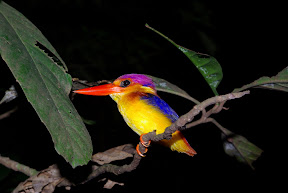
During our stay we participated in 7 boat safaris, and 3 jungle walks, which took place day and night. Sightings ranged from the fleeting glance of proboscis monkeys (a rare, Borneo endemic) leaping through the trees at sundown to a techni-colored kingfisher perched mere inches from us on a branch during our night walks (which our guide teased was a plastic bird he had placed there hours before) to countless flyovers by beautiful and charismatic oriental pied hornbills. The haunting calls of the Borneo gibbons (another primate) and their amazing speed as they swung from tree to tree will be unforgettable. The highlights of the trip occurred bright and early during the 6:30am river safaris on days three and four. On both days we had the great fortune to watch a single female orangutan feeding on fig fruit in a tree above us no more 20-30 feet away. The experience of watching these close human relatives in the wild was surreal (our DNA varies by only about 3%). All in all, we saw 6 primate species, numerous birds, lizards, frogs, crocodiles, and countless insects (see below for the complete list) during our trip.

Sitting here gazing at the mist shrouded foothills of Mt. Kinabalu we already miss the Kinabatangan. The lowland forest of Borneo, home to orangutans and countless other creatures, is an enchanting place that literally breathes biodiversity. As botanists, conservationists and lovers of nature, this habitat will hold a special place in our hearts. The Kinabatangan exists at a crossroads. Only time will tell what the future holds for Borneo’s orangutans, proboscis monkeys and gibbons.

A Partial List of What We Saw

Mammals

Borneo gibbon (seen 3 times)

Flying squirrel

Orangutan (seen 4 times, 6 individuals)

Palm civet

Pig-tailed macaque

Plant pygmy squirrel

Proboscis monkey

Long-tailed macaque

Silver leaf monkey

Birds (not an exhaustive list-we are, by no means, birders)

Bee-eaters

Black-backed kingfisher

Black and red broadbill

Blue-eared kingfisher

Crested serpent eagle

Little pied flycatcher

Oriental pied hornbill

Owls

Red fish eagle

Stork-billed kingfisher

White-bellied fish eagle

Reptiles and Amphibians

Comb-crested agamid lizard

Grass frog

Frogs (at least 4 other species)

Monitor lizard

Other lizards and skinks

Saltwater crocodile

Continue Reading...

Sunday, July 25, 2010

Welcome to Borneo


25 July 2010
After an early morning flight we arrived in Sandakan, on the island of Borneo in the Malaysian state of Sabah. We quickly made our way to Sepilok, home to one of four orangutan rehabilitation centers in the world and the starting point of tomorrow's trip up the Sungai (River) Kinabatangan (try saying that 3 times in a row). This marks the start of 3+ weeks exploring Borneo- the third largest island in the world, a haven of biodiversity, and a place where the battle between conservation and economic development is waged on a daily basis.

After settling in to Uncle Tan's, our base for the night, we set out on foot for a visit to the Rainforest Discovery Center. The Center is home to a beautiful botanical garden, several miles of trails, canopy walkways and bird observation towers. Walking on the trails amidst butterflies and scurrying lizards we arrived at the Hornbill Observation Tower. Hornbills are large forest birds with large bills, which are symbols of the islands faunal diversity. As we climbed the observation tower, perched well over 100 feet high into the tree canopy we tried to ignore the distant thunder and darkening clouds on the near horizon (it wouldn't pour on us our first day in Borneo, would it?). After minute or two at the top, we could not ignore the approaching storm. We watched as a strong persistent wind suddenly appeared and the thunder took on a more ominous tone. Just then we notices hundreds of brown "helicopters" aloft emanating from the dipterocarp trees, which dominate the forest canopy. The seeds of these trees are perfectly suited for wind dispersal and took flight beautifully in the stiff wind. Fearing the worse we hightailed it back in the direction of the Center's headquarters-hoping for a weather miracle. About half of the way back we were caught in the storm, but we were serendipitously close to a nearby shelter-yes! There, in the shelter, we spent the next hour or so-waiting out the storm. If you have ever experienced a hard tropical rain you know that rain gear is no match (you would just sweat inside it anyway) and umbrellas offer little real protection. If it weren't for the shelter we would have been drenched to the bone an hour away from home in mere seconds.

As the storm began to pass and the thunder faded into the distance we made our way back to our guesthouse. About half of the way back we noticed three large bird silhouettes in a dead tree not to far in the distance. Upon closer inspection and after viewing their shape in flight their identification was unmistakable. Hornbills!

And, so starts the Borneo portion of our adventure. Tomorrow we visit the Sepilok Orangutan Rehabilitation Center to learn about the resident great apes and the efforts to conserve them. In the afternoon we head out for 3 nights on the Kinabatangan River, where we hope to see orangutans and much more in the the wilds of Borneo.
Continue Reading...
 

Who we are

We, Nick and Rachel, are a couple of world-traveling botanists from California in search of adventure, exciting food, culture and nature. This blog is our attempt to keep in touch with our friends, family, and followers as we explore Asia and beyond over the next 10+ months starting in early-July 2010. I hope you enjoy our stories, photos, and experiences.


Our Plan


View The Plan in a larger map


2010

July-Mid-August : Malaysia
Mid-August-October: Indonesia
October-November: Nepal
Late-November-Early December: India
late-December: Nepal

2011

January-February:
Thailand, Laos, Cambodia

Late February, March-April: New Zealand
Late April: Fiji
Home

One Long Weekend Copyright © 2009 Blogger Template WoodMag is Designed by Ipietoon for Free Blogger Template